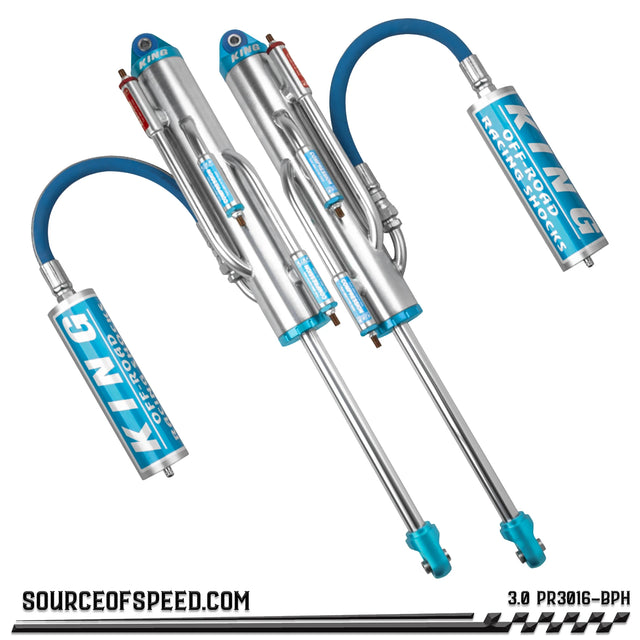
King 3.0 3-Tube Bypass Remote Reservoir | 16.00" Stroke
King 3.0 3-Tube Bypass Remote Reservoir | 16.00" Stroke - King Layout-1 is backordered and will ship as soon as it is back in stock.
Description
Description
King 3.0 3-tube bypass shocks built to your specification.
- 3.0" Shock
- 16.00" Travel
- 1.00" Shaft
- Fixed top cap
- 2.50" Hose remote reservoir
- 26.20" Compressed length (Standard length rod end)
- 42.40" Extended length (Standard length rod end)
- Sold as a matching pair, left and right
3/4" Bypass Tubes: (must be spaced 35°+ degrees apart)
- C1 - Long compression
- C2 - Medium compression
- R1 - Long rebound
For custom bypass layout, download PDF Order form in the blue box, fill out all information and email to sos@sourceofspeed.com and we will contact you to review all the details and confirm your order. Should you need help with select items, skip them, and complete as much as possible - SOS
/// King Performance Race Series Bypass Shocks are built from the same materials and manufacturing tolerances as King Race Series shocks. Product images are for reference only and may not reflect the exact configuration selected.
▶ Understanding External Bypass Shocks (Diagram)
/// External bypass shock is a position-sensitive shock absorber that uses external bypass tubes to control hydraulic oil flow throughout different stages of the suspension's travel. Unlike a conventional shock, which uses a single damping circuit throughout its travel, an external bypass shock uses multiple independently adjustable damping zones to control suspension performance throughout the stroke.
Each bypass tube controls hydraulic oil flow within a specific damping zone of the shock's travel, allowing suspension performance to be independently tuned throughout compression and rebound. This provides precise control over damping characteristics as the shock moves through its stroke.
By adjusting each bypass valve, damping can be precisely tuned throughout the shock's travel to optimize low-speed and high-speed suspension performance while providing controlled bottom-out and top-out resistance for the intended vehicle application.
/// Compression damping controls how the suspension reacts as the shock compresses. Compression bypass adjusters face downward because hydraulic oil flows through the compression circuit only during compression.
Each compression bypass tube is positioned to control a specific portion of the shock's travel. Closing a compression bypass valve restricts oil flow, increasing compression damping within that zone and making the suspension more resistant to compression. Opening the valve allows more oil to bypass the piston, reducing compression damping and allowing the suspension to compress more freely.
Because each compression tube controls its own section of travel, damping characteristics can be progressively tuned throughout the suspension stroke instead of remaining the same from beginning to end.
/// Rebound damping controls how the suspension reacts as the shock extends after being compressed. Rebound bypass adjusters face upward because hydraulic oil flows through the rebound circuit only during rebound.
Each rebound bypass tube is positioned to control a specific portion of the shock's travel. Closing a rebound bypass valve restricts oil flow, increasing rebound damping within that zone and slowing suspension extension. Opening the valve allows more oil to bypass the piston, reducing rebound damping and allowing the suspension to extend more freely.
Proper rebound tuning helps maintain tire contact with the terrain, improves vehicle stability, and prevents the suspension from extending too quickly after an impact.
/// Overlapping Bypass Zones
Each bypass tube is positioned to control a specific section of the shock's travel, but those sections are not always independent. When two bypass tubes overlap, both bypass circuits are active within that portion of the stroke.
Instead of one bypass tube abruptly handing control to another, their damping characteristics blend together as the suspension moves through the overlap. This creates smooth transitions between damping zones while allowing each section of the suspension travel to be tuned independently.
By combining multiple bypass tubes with overlapping zones, an external bypass shock can deliver a suspension that remains compliant during normal operation while progressively increasing control where additional damping is needed.
/// External Bypass vs. King Internal Bypass (IBP)
Both external and King Internal Bypass shocks provide position-sensitive damping, but they achieve that control differently.
An external bypass shock routes hydraulic oil through independently adjustable bypass tubes mounted outside the shock body. Each compression and rebound stage can be tuned separately, providing maximum external control over damping throughout the stroke. King describes each external bypass stage as separately tunable, position-sensitive, and independently operating
A King Internal Bypass (IBP) uses a full-diameter piston, full-size valve shims, and a special hollow shaft that feeds the Ride Valve Chamber. During normal travel, the primary piston and Ride Valve Chamber provide high fluid flow for compliance over smaller terrain. As the shock approaches the end of compression, a tapered metering rod progressively closes the hollow-shaft ports, reducing flow and increasing damping resistance to create a controlled position-sensitive bump zone.
/// External Bypass Shocks
remain the preferred configuration when independently adjustable external compression and rebound stages and maximum tuning flexibility are required.
Proudly made in the U.S.A.
Shop with confidence
YOUR PRIVACY IS OUR PRIORITY. ALL TRANSACTIONS ARE PROCESSED THROUGH SECURE, ENCRYPTED PAYMENT GATEWAYS. SOURCE OF SPEED NEVER STORES YOUR CREDIT CARD INFORMATION, AND OUR TEAM DOES NOT HAVE ACCESS TO YOUR PAYMENT DETAILS.
Product features
100% made in the USA under the strictest tolerances from
the highest quality materials obtainable.
Fully serviceable, with all components available to purchase separately to fully rebuild or repair.

External Bypass Diagram